

We are not approaching the end of the smartphone era we are approaching the end of the screen era itself.
The Beginning of the End for the Pocket Rectangle
The smartphone is the most successful consumer technology product in history. Over two billion people carry one. It woke us up this morning, navigated us to work, processed our payments, and will probably be the last thing we look at before sleep.
And yet, quietly but unmistakably, the world’s most powerful technology companies have begun building its successor.
This is not rumor or analyst speculation. Apple, Google, Meta, and Samsung have collectively committed hundreds of billions of dollars to research, acquisitions, and product development aimed at one goal: creating a computing paradigm that makes the touchscreen smartphone feel as dated as the rotary telephone.
This article goes deep. Not just what is coming, but why, how, the genuine obstacles standing in the way, and what it will actually feel like to live on the other side of this transition.
Part 1: Why Smartphones Are Running Out of Road
The Innovation Plateau
Walk into any phone store today and compare a flagship from 2025 to one from 2021. The differences a better camera, a slightly faster processor, a marginally brighter display are real but incremental. The fundamental experience is identical: a glass rectangle you tap with your fingers.
This plateau is not a failure of engineering. It is a sign of maturity. Smartphones have converged on a near-optimal form for what they are. There is simply not much left to reinvent within the rectangle.
Consumer behavior reflects this. Upgrade cycles have stretched from 18 months a decade ago to over three years today. People are not upgrading because there is no compelling reason to.
The Friction Problem
Smartphones require you to stop and look. Every notification, every search, every map check pulls you out of the physical world and into a glass screen. Over time, this friction accumulates into something that researchers now call continuous partial attention a state where we are never fully present anywhere.
The next era of computing is being designed around a different principle: technology should come to you, not the other way around.
The AI Inflection Point
The arrival of capable, generalized AI has changed what a “smart device” can actually do. A smartphone running a large language model is not just faster at the same tasks it is capable of fundamentally different ones: understanding context, anticipating needs, handling multi-step tasks autonomously, and communicating in natural language.
This capability does not require a touchscreen. It does not require a screen at all.
Part 2: The Technologies Building the Post-Smartphone World
2.1 Augmented Reality Glasses: The New Primary Screen
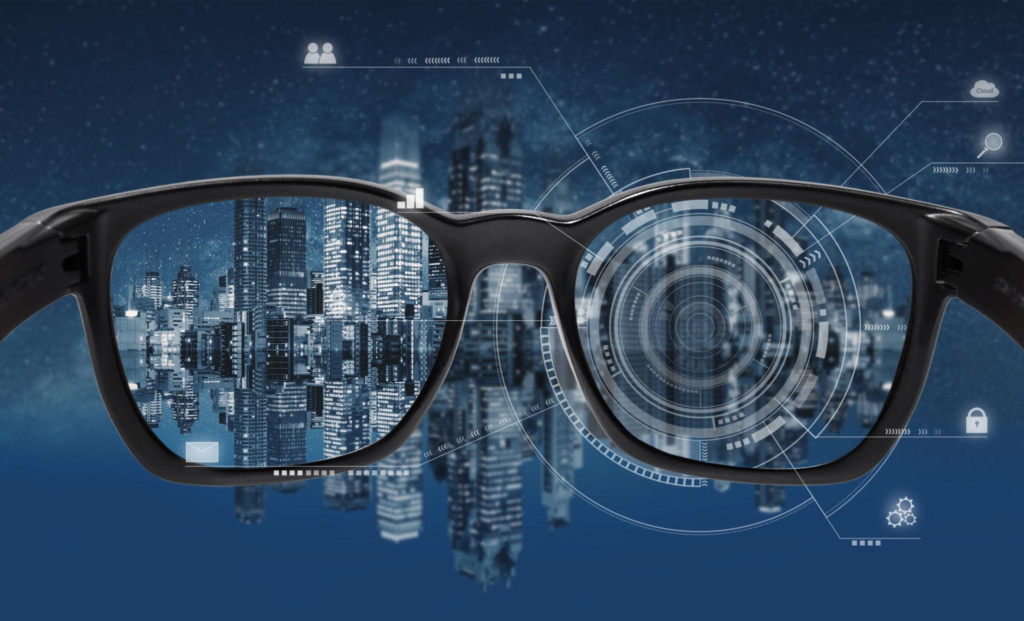
AR glasses are the most likely candidate for the device that dethrones the smartphone, because they solve the friction problem entirely. Instead of pulling your phone from your pocket, information appears in your field of vision, layered over reality.
What mature AR glasses will actually do:
- Display turn-by-turn navigation as arrows floating on the road ahead of you
- Show caller ID and message previews without breaking eye contact in a conversation
- Translate foreign-language text in real time as you read it
- Identify products, landmarks, and people (with consent frameworks) and surface relevant information instantly
- Project a virtual workspace monitors, documents, and applications visible only to you, anywhere you are
Where the major players stand:
Apple’s Vision Pro, launched in 2024, is a spatial computing headset rather than glasses too large and expensive for daily wear, but a proof of concept for the ecosystem. Apple’s internal roadmap is widely reported to target lightweight AR glasses as a natural evolution of this platform.
Meta has invested more aggressively than any other company in consumer AR. Its Ray-Ban Meta smart glasses a collaboration with EssilorLuxottica represent an early-stage product: they capture photos, play audio, and run a voice AI assistant. The next generation is expected to add a display. Meta’s long-term goal, Project Orion, aims for full holographic AR glasses by the end of the decade.
Google, after the public failure of Google Glass in 2013, has returned to the space with hard lessons learned. Its current work focuses on AI-native glasses with a narrower, more practical feature set real-time translation, navigation, and assistant functions rather than trying to do everything.
Samsung, in partnership with Google’s Android and Gemini AI teams, is developing its own AR glasses platform, with hints of a product emerging before 2027.
The hard truth: Even optimistic timelines place genuinely compelling, all-day-wearable AR glasses at 2028–2032. The optical engineering, battery constraints, and social dynamics of wearing a computer on your face are all unsolved problems at scale.
2.2 AI Assistants: From Apps to Intent
The current model of smartphone interaction is app-based: you want to book a flight, so you open a travel app, search for flights, filter results, enter payment details, and confirm. Each step requires your active attention and input.
The emerging model is intent-based: you say “book me the cheapest flight to Mumbai that gets me there before noon on Friday,” and the AI handles every step searching, comparing, filling forms, processing payment and reports back with a confirmation.
This is not a distant vision. The infrastructure for it exists now. What is being built is the layer of trust, verification, and reliability required for people to hand over that kind of agency.
What this means in practice:
- AI assistants that know your preferences, schedule, relationships, and habits deeply enough to act as genuine proxies
- The concept of “opening an app” fading away, replaced by conversational requests
- A dramatic reduction in the number of apps you use, as AI handles task routing behind the scenes
This shift is sometimes called the death of the app store era a transition as significant as the shift from desktop software to mobile apps was in 2008.
2.3 Wearable Technology: The Body as Interface
Wearables are evolving from fitness trackers into genuine computing platforms.
Smartwatches have already eaten significant smartphone functionality. Apple Watch handles calls, messages, payments, navigation, and health monitoring without needing the iPhone in reach. Future iterations are expected to run AI assistants locally, reducing smartphone dependence further.
Smart rings led by Samsung’s Galaxy Ring and competitors like Oura are pioneering ultra-discreet continuous health monitoring: heart rate variability, sleep staging, blood oxygen, stress markers, and early illness detection. The ring’s small size limits its display and interaction capabilities, but as a sensor node feeding data to an AI assistant, it is highly capable.
AI-powered earbuds may be the most underestimated category. Devices like the latest AirPods can already do real-time language translation. Future earbuds will run persistent AI assistants that listen contextually (with clear privacy controls), answer questions, manage communications, and guide you through tasks entirely through audio. For many routine smartphone interactions checking the time, sending a message, asking a question audio-first interaction is genuinely faster and less disruptive.
2.4 Ambient Computing Technology That Disappears
The most profound shift may be the least visible: computing that requires no device interaction at all.
Smart homes have moved well beyond voice-activated speakers. The next generation of home AI will understand context: knowing that when you arrive home stressed on a Tuesday after a long commute, you probably want the lights dimmed, a specific playlist, and the thermostat at a particular temperature without being asked.
Smart vehicles are becoming rolling computing platforms. A car equipped with AI and AR can overlay navigation, hazard warnings, and relevant information directly on the windshield. It can handle communications, manage your schedule, and brief you on your day during your commute.
Connected workplaces will adapt to occupants: adjusting lighting and acoustics for focus or collaboration, surfacing relevant documents as meetings begin, and managing communications intelligently.
The unifying principle: technology recedes into the background and surfaces only when needed, rather than demanding constant active attention.
2.5 Spatial Computing and Mixed Reality
Spatial computing refers to digital experiences that exist in three-dimensional space rather than on a flat screen. It encompasses both Augmented Reality (digital overlays on the real world) and Virtual Reality (fully immersive digital environments).
Practical near-term applications:
- Education: Students studying anatomy in 3D, with organs they can rotate, dissect, and examine from any angle, rather than reading flat diagrams in textbooks
- Healthcare: Surgeons using AR overlays during procedures to visualize anatomy beneath the surface they are operating on; medical students training in fully simulated surgical environments
- Remote collaboration: Colleagues in different cities sitting at a virtual table together, manipulating shared 3D objects, with spatial audio that makes distance irrelevant
- Retail: Trying furniture in your actual living room before purchasing, or test-driving a car configuration in your own driveway
- Entertainment: Games and experiences that exist in your physical space, responsive to your actual environment
Part 3: A Realistic Timeline
The honest answer to “when will smartphones be replaced?” is: gradually, then suddenly and differently for different people.
| Period | What to Expect |
|---|---|
| 2025–2027 | AI assistants become dramatically more capable and integrated. Smart glasses hit a genuinely usable early-adopter form factor. Wearables absorb more smartphone use cases. |
| 2028–2031 | Lightweight AR glasses reach mass-market form factor and price. For many tasks, people prefer glasses or earbuds to pulling out a phone. |
| 2032–2035 | Post-smartphone devices reach mainstream adoption. Smartphones remain common but are no longer the default primary device for most interactions. |
| 2035 and beyond | Smartphones persist as specialized tools for specific use cases, the way laptops persist today useful, but not always the first device you reach for. |
These timelines assume continued progress without major regulatory, technical, or economic disruptions a significant assumption.
Part 4: What Tech Giants Are Actually Building
Apple
Apple’s strategy is characteristically long-term and ecosystem-driven. The Vision Pro headset established the spatial computing framework the software architecture, developer tools, and user experience patterns that future, lighter devices will inherit. Apple’s supply chain investments in micro-OLED displays and custom silicon suggest the company is engineering toward glasses-form-factor hardware seriously. The company’s health sensor research, combined with Apple Watch, points toward an increasingly capable wearable ecosystem that could function independently of iPhone.
Meta
Meta has bet its entire future on the metaverse and AR. After writing down billions in early metaverse losses, the company’s Ray-Ban Meta glasses are its first genuine consumer success in hardware. CEO Mark Zuckerberg has described AR glasses as potentially the most important technology the company has ever worked on. Meta’s advantage is its social infrastructure if AR glasses become the primary social communication tool, Meta’s platform position is formidable.
Google’s AI capabilities Gemini, DeepMind, years of search and language model research position it uniquely for a world where AI is the primary interface. Google’s challenge has historically been hardware and ecosystem consistency. Its current smart glasses work focuses on AI-native use cases where its models provide a genuine advantage: translation, visual search, and assistant capabilities.
Samsung
Samsung is the world’s largest smartphone manufacturer, which gives it both the most to lose from the smartphone’s decline and the manufacturing scale to lead its successor. Its partnership with Google on Android XR (the mixed reality operating system) and its Galaxy AI initiatives signal a company that is not waiting to be disrupted.
Part 5: The Real Obstacles
Progress is real, but so are the challenges. Several problems remain genuinely hard.
Optical Engineering
Making AR glasses that look like normal eyewear thin, lightweight, stylish while fitting in waveguides, displays, processors, cameras, and batteries is an extraordinary engineering challenge. Current solutions involve compromises that are acceptable for early adopters but not for the mass market.
Battery Life
Every wearable device fights the same war against physics. Processors need power. Displays need power. Radios need power. Batteries have not improved at the same rate as processing capability. Until battery technology makes a step-change improvement solid-state batteries, new chemistries wearable devices will continue making painful trade-offs between capability and all-day use.
Privacy Architecture
A device that sees what you see, hears what you hear, and knows where you are at all times is a surveillance instrument of unprecedented intimacy. Building these devices in a way that genuinely protects user privacy not just in policy but in architecture is both a technical and a political challenge. Regulatory frameworks in Europe, the US, and elsewhere are still being written. Public trust needs to be earned, not assumed.
Social Dynamics
Early Google Glass users were called “Glassholes.” The stigma of visibly wearing a camera-equipped computer on your face is real, and it takes time and cultural change to normalize. This is not an engineering problem it is a human one, and it cannot be engineered away on a schedule.
Accessibility and Inclusion
The early generations of post-smartphone technology will be expensive. If the cost barrier is not actively addressed, these technologies risk creating a new layer of digital inequality dividing people not just by smartphone access but by access to the ambient computing layer that will increasingly mediate work, healthcare, and social participation.
Part 6: What This Means for You
The post-smartphone transition will not arrive as a single product launch. It will arrive as a gradual accumulation of small shifts:
- You will start using your phone less to check the time, because your watch tells you
- You will start sending messages by voice more often, because it is faster
- You will stop opening certain apps because your AI assistant handles those tasks in the background
- One day you will realize you left your phone at home and did not particularly miss it for most of the morning
The transition is already underway. The question is not whether it will happen, but how to navigate it thoughtfully as a user, as a professional, and as a citizen thinking about what kind of technological future we want to build.
Conclusion: Not a Replacement, But a Transformation
The post-smartphone future is not a single device arriving to replace the one in your pocket. It is an ecosystem glasses, earbuds, rings, watches, ambient environments, and AI that together provide what smartphones provide today, but woven more naturally into the fabric of daily life.
Smartphones will not disappear. They will become what laptops became after smartphones arrived: still useful, still widely owned, but no longer the device you reach for first.
What is being built is something more interesting than a better phone. It is a different relationship between people and technology one where the technology is less visible, less demanding, and ideally more genuinely useful.
Whether that future is liberating or intrusive depends almost entirely on the choices made now: in design studios, in legislative chambers, and by people deciding what they will and will not accept from the devices they invite into their lives.
Technologies referenced: AR/XR, ambient computing, spatial computing, AI assistants, smart wearables, intent-based computing, mixed reality