The 2026 Ford F-150 is not the same truck your dad drove to a job site. It’s not even close. Ford’s best-selling pickup now ships with more computing power than most people’s home offices — and whether that’s genuinely useful or just expensive window dressing depends entirely on how you work and drive.
This post breaks down every major tech upgrade in the 2026 F-150, what each feature actually does in the real world, and where Ford’s engineers nailed it versus where they’re still working out the kinks.
SYNC 4 Infotainment: A Real Upgrade, Not Just a Bigger Screen
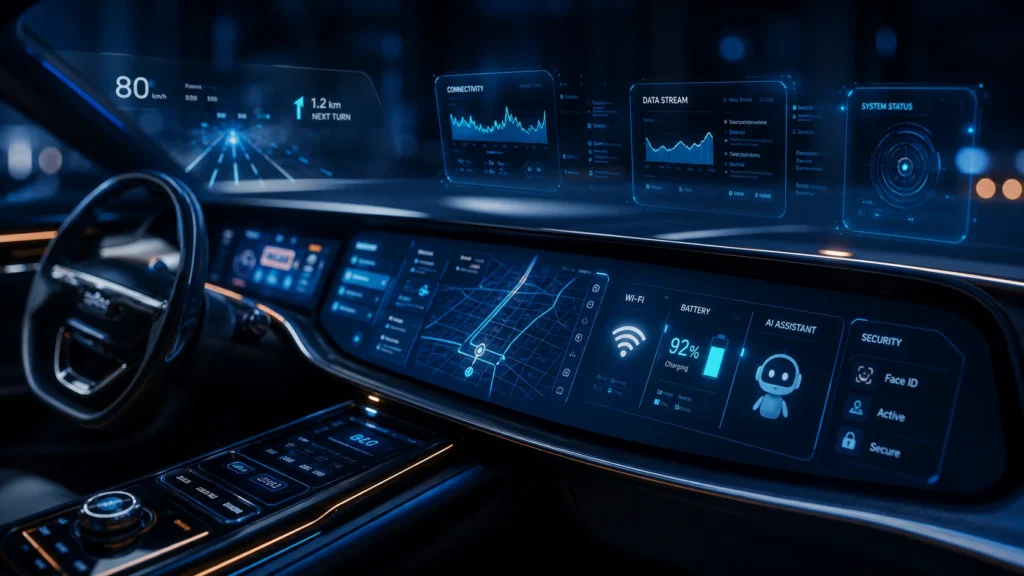
Every 2026 F-150 — including the base XL work truck — now comes with a 12-inch SYNC 4 touchscreen as standard. That’s a meaningful shift. Fleet buyers who previously got stripped-down cabins now get a system that rivals luxury sedans from five years ago.
SYNC 4 uses swipe navigation that works like your phone: gesture-based, fast to respond, split-screen capable. It supports over-the-air (OTA) updates, so Ford can push improvements to the software without you ever visiting a dealership. Higher trims unlock SYNC 4A, which comes with a portrait-oriented 15.5-inch display and deeper voice command integration.
The 12-inch digital instrument cluster — standard on most trims — shows real-time driving data, navigation, and media without requiring you to look away from the road. A head-up display (optional from the Lariat trim upward) projects speed and alerts directly onto the windshield.
Wireless Apple CarPlay and Android Auto are standard across all trims. No cables, no fumbling. You connect once and your phone hooks in automatically.
BlueCruise Hands-Free Driving: Useful, With Caveats
BlueCruise is available from the Lariat trim and upward, and it’s the 2026 F-150 smart tech feature that generates the most questions — and the most debate.
On mapped highways (over 130,000 miles of designated Hands-Free Blue Zones), the truck handles steering, speed, and even lane changes without your hands on the wheel. You activate your turn signal, and BlueCruise executes the lane change when it determines the gap is safe. A cabin-facing infrared camera monitors your eyes to make sure you stay alert.
Here’s the honest take: BlueCruise works well on long highway stretches where driving fatigue is a real problem. It’s a genuine fatigue reducer on cross-country hauls. But it’s not a set-it-and-forget autopilot, and Ford doesn’t market it as one. The system requires you to remain engaged and ready to take over. For drivers who do a lot of long-distance highway miles, it earns its keep. For contractors who spend most of their time on surface streets and job sites, it may not justify the upgrade cost.
One important comparison: GM’s Super Cruise, available on the Silverado High Country, supports hands-free towing on compatible highways — something BlueCruise still cannot do. If towing hands-free matters to you, that’s worth factoring into your decision.
Ford Connectivity Package: The Wi-Fi Upgrade Worth Understanding
New for 2026 is the Ford Connectivity Package, included free for the first year on equipped trims. It adds an unlimited Wi-Fi hotspot that powers up to 10 devices simultaneously, Connected Navigation with real-time traffic and map updates, a voice assistant, and — while parked — YouTube streaming.
That last part sounds silly until you’re waiting on a job site with an hour to kill, or you’re running a mobile office out of your cab. Then it makes more sense.
The FordPass app ties into all of this. You can remotely start or stop the truck, lock and unlock it, check vehicle status, send navigation destinations from your phone to the truck’s system, set up customizable theft alerts, and — if the truck goes missing — get 24/7 access to Ford agents who coordinate with law enforcement to track and recover it.
After the first year, the connectivity package requires a subscription. That’s the part Ford buries in the fine print. Factor it into your total cost of ownership calculation before you fall in love with the feature set.
Pro Power Onboard: The Generator Nobody Talks About Enough
This one flies under the radar in most tech roundups, which is strange because it’s arguably the most practically useful feature Ford builds into the F-150.
Pro Power Onboard turns the truck bed into a portable power station. Available on select trims and engine configurations (including the PowerBoost Full Hybrid), it delivers 2.0 kW or 7.2 kW of exportable power depending on the configuration. That’s enough to run power tools, lights, a job site cooler, camping gear, or emergency home appliances.
The PowerBoost hybrid variant — a 3.5L twin-turbo V6 with an electric motor producing 430 horsepower and 578 lb-ft of torque — comes with the 7.2 kW Pro Power system standard. You plug tools directly into the bed outlets. No generator trailer. No extension cords running to a separate machine. For contractors and tradespeople, this is the tech feature that genuinely changes how you work.
Ford Co-Pilot360 2.0: Safety Tech That’s Now Standard Across the Board
Every 2026 F-150 comes with Ford Co-Pilot360 2.0, which bundles together a suite of safety features that used to cost extra:
- Pre-Collision Assist with Automatic Emergency Braking — detects vehicles and pedestrians ahead and brakes autonomously if you don’t react in time
- BLIS (Blind Spot Information System) with Trailer Coverage — monitors your blind spots and extends coverage to whatever you’re towing, not just the truck itself
- Lane Keeping System — alerts you when you drift and applies steering correction
- Intersection Assist — warns you about oncoming traffic when turning at intersections
Moving up to the Lariat and above adds Adaptive Cruise Control with Stop-and-Go and Lane Centering, evasive steering assist, and the Heads-Up Display. The 360-degree camera system available on higher trims gives you a bird’s-eye view of the truck when parking or maneuvering a trailer into a tight spot.
The Trailer Backup Assist feature lets you steer a trailer with a rotary knob rather than trying to manage the counterintuitive mirror-to-wheel coordination that makes trailer backing so frustrating. You turn the knob the direction you want the trailer to go, and the truck handles the rest. It’s one of those features that sounds gimmicky until you’ve used it twice.
Interior Work Surface and the Rolling Office Concept
The 2026 F-150’s available Interior Work Surface converts the center console area into a fold-down desk. Combined with the connectivity package, the digital display, wireless charging, and multiple USB ports, the cab becomes a functional mobile workspace.
This matters for anyone who spends significant time on job sites or in transit between client meetings. You can review plans, take video calls, charge your devices, and access navigation — all without leaving the truck. For fleet managers, Ford Pro telematics integration adds vehicle health monitoring, driver behavior tracking, and maintenance scheduling across an entire fleet.
The Honest Price Check
Here’s something most reviews skip. To access the full suite of 2026 F-150 smart tech features — BlueCruise, the large SYNC 4A display, Pro Power Onboard 7.2 kW, and the connectivity package — you’re looking at a Lariat trim or higher, which starts around $57,000 and climbs quickly with packages. Add BlueCruise and the connectivity upgrades, and you’re easily past $65,000 before you touch off-road packages, bed accessories, or premium audio.
A base XL with the standard 12-inch touchscreen, Co-Pilot360 safety suite, and Apple CarPlay starts around $39,330. You lose the fancy Wi-Fi, hands-free driving, and the 7.2 kW generator but you also save $25,000+ and pay zero subscription fees.
For drivers who genuinely need BlueCruise and Pro Power, the higher trim earns its price. For contractors who need a truck to haul and tow reliably, the base tech stack is honestly quite good for the money.
Final Take
The 2026 F-150 smart tech features represent a real leap forward. The base infotainment is no longer embarrassing. The safety suite is now standard rather than optional. Pro Power Onboard remains one of the most useful innovations in the truck segment. And BlueCruise, used correctly on long highway stretches, genuinely reduces driver fatigue.
But the subscription model lurking behind some of these features deserves scrutiny. And if your primary use is construction, ranching, or heavy towing — rather than commuting on mapped highways — some of the headline features may not be worth the premium over a well-equipped XLT.
The tech is real. Just make sure you’re buying the features your work actually needs, not the ones that look best in a brochure.
Frequently Asked Questions
1. What is the Ford Connectivity Package in the 2026 F-150, and is it free?
The Ford Connectivity Package is new for 2026 and provides an unlimited Wi-Fi hotspot for up to 10 devices, Connected Navigation with real-time updates, a voice assistant, and YouTube streaming while parked. It’s included free for one year on equipped trims. After the trial period expires, it requires a paid subscription. Check current Ford pricing for ongoing subscription rates before factoring it into your budget.
2. Which 2026 F-150 trims get BlueCruise hands-free driving?
BlueCruise is available starting at the Lariat trim and is also offered on higher trims like King Ranch, Platinum, and Limited. It’s not available on the base XL or XLT without specific packages. BlueCruise enables hands-free driving on over 130,000 miles of pre-mapped Hands-Free Blue Zones (primarily U.S. and Canadian highways) and includes an automatic lane change feature when you activate the turn signal.
3. Does the 2026 F-150’s SYNC 4 system receive over-the-air updates?
Yes. The SYNC 4 and SYNC 4A systems in the 2026 F-150 support over-the-air (OTA) software updates. Ford can push improvements, bug fixes, and new features wirelessly without requiring a dealership service visit. This means your infotainment system can improve over time after purchase.
4. What is Pro Power Onboard, and which 2026 F-150 engines offer the highest output?
Pro Power Onboard is Ford’s built-in mobile generator that provides exportable electrical power through outlets in the truck bed and cab. The 2026 F-150 offers 2.0 kW on some engine configurations and 7.2 kW on the PowerBoost Full Hybrid (3.5L twin-turbo V6 hybrid). The 7.2 kW option is powerful enough to run heavy power tools, multiple devices, and even appliances during a power outage.
5. Is Ford Co-Pilot360 standard on all 2026 F-150 trims?
Yes. Ford Co-Pilot360 2.0 is standard on every 2026 F-150 trim, including the base XL. It includes Pre-Collision Assist with Automatic Emergency Braking, BLIS with Trailer Coverage, a Lane Keeping System, and Intersection Assist. Higher trims add Adaptive Cruise Control with Stop-and-Go, Lane Centering, evasive steering assist, and a Heads-Up Display.
6. How does the 2026 F-150’s tech compare to the Chevy Silverado 1500?
The Silverado 1500’s Super Cruise system (available on the High Country trim) holds one key advantage: it supports hands-free driving while towing a trailer on compatible highways — something BlueCruise in the F-150 does not currently offer. For drivers who tow frequently on long highway routes, that’s a meaningful difference. In terms of infotainment, both trucks offer large touchscreens with wireless smartphone integration and OTA update capability. The F-150’s Pro Power Onboard generator system remains a feature with no direct Silverado equivalent in terms of bed-integrated power output.